




UWB Got Hacked With a $65 Board: Here's How
A thief stands at the far end of a car park, twelve metres from your car. In his hand is a circuit board that cost sixty-five dollars. Your phone, the digital key that unlocks the car as you approach it, sits in your pocket on the other side of the lot. The car should read you as far away. Instead it places your phone right at the door, and the lock clicks open.
Researchers at ETH Zurich and TU Darmstadt did exactly this, against the same Ultra-Wideband (UWB) chips that ship in iPhones, AirTags, and production digital car keys.
Earlier in this series, we built UWB up as the secure ranging radio. It measures distance by timing a radio pulse to a fraction of a nanosecond, and that timing is meant to be hard to fake. Our piece on “The Honest State of UWB” told the truth about the supply chain and the regulation. This one tells the truth about security claims.
From car entry and start, mobile payments, smart locks down to badge-free building access. Every one of them trusts a distance measurement to decide whether to open or not (proximity is the password). So the question worth your time is obvious. How much can you trust that measurement, and what happens to your product when someone sets out to break it?
Why Everyone Decided UWB Was the Safer Route
UWB earned its security reputation honestly. A pulse that lasts under a nanosecond lets a receiver timestamp a signal’s arrival to a fraction of a nanosecond, and precise timing means precise distance. In essence, the radio measures how far away your key is and keeps the lock shut unless you are genuinely close. That is the foundation of secure ranging! It is also what defeats a relay attack.
The Bucket Brigade, Foiled: In Theory
In a relay attack, two accomplices run a bucket brigade for your key’s signal. One stands near the key in your hallway, the other near your car in the driveway, and they pass the signal between them so the car believes the key is at the door. Distance-bounding breaks the brigade, because the relayed signal takes longer to arrive, and the extra travel time gives the lie away.
Precise UWB ranging is older than its security. The first ranging-capable UWB standard landed in 2007 and measured distance to the centimetre, with no protection against someone faking the timing. The fix came in 2020, when the IEEE 802.15.4z amendment added the Scrambled Timestamp Sequence (STS: an unpredictable, encrypted field inside the ranging exchange, built from an AES key the two devices share, that the receiver uses to confirm a measurement is real).
STS is what turned accurate ranging into secure ranging. That history carries a useful implication: UWB’s security is an add-on, written in through a standards amendment years after the radio shipped, which means the same process can revise it. The weaknesses researchers keep finding sit within reach of a future amendment, the same way the original security was.
This is the promise the industry bought into. When carmakers wanted your phone to unlock the car as you walk up to it, they needed proof the phone was genuinely at the door, rather than relayed from inside your house.
The Car Connectivity Consortium (CCC: the group that defines how phones unlock cars) wrote UWB secure ranging into its Digital Key standard for exactly that, and the FiRa Consortium (Fine Ranging: the body that certifies UWB devices from different vendors work together) built it into its certification program. So when a car opens to your phone today, an STS-protected distance measurement is the thing deciding you are close enough to let in.
So far, so trustworthy. We’ve covered more of that in a previous post – UWB vs BLE vs Wi-Fi.
A $65 Board Made Twelve Metres Look Like Zero

In 2022, at the USENIX Security Symposium, a team from ETH Zurich and TU Darmstadt presented Ghost Peak. The first over-the-air attack that shortens a UWB distance measurement. Capable of cutting a measured distance from twelve metres to zero, the attack hardware cost only sixty-five dollars.
The team ran Ghost Peak against Apple’s U1 chip (the UWB radio in iPhones and AirTags) working with NXP’s SR040 and SR150 and Qorvo’s DWM3000: the families behind shipping digital car keys. In one run on a pair of Qorvo development boards left under attack for roughly seventy-two hours, they logged forty-two successful distance reductions. During each one, the receiver’s own check on the STS reported the signal as valid while the distance it returned was metres short of the truth.
A single exchange falls to the attack only 4% of the time. Four percent sounds too small to worry about, until you picture how the attack actually runs. The thief gets unlimited tries. He stands by the car and lets the attack fire on every ranging attempt the phone makes, and roughly one in twenty-five of those attempts hands him an open door.
The car, meanwhile, has no way to compensate: it decides in a fraction of a second, on a single measurement, with no time for a second opinion. A one-in-twenty-five shot repeated all day, against a lock that opens on the first success, is a break-in waiting to happen.
The radio told the system the key was at the door, and the system had no reason to doubt it.
How to Fool a Radio Without the Keys
How do you fake a distance without first breaking the encryption? You attack the one thing the encryption leaves exposed: which echo the receiver believes arrived first.
Picture a receiving dock that logs a delivery by the first truck through the gate. By default, the system trusts the earliest arrival as the genuine one. Send a decoy vehicle through ahead of the real truck, and the log records an arrival earlier than anything that actually delivered goods. The clock was honest. However, the first thing it saw was a fake.
UWB ranging has the same Achilles heel. To stay accurate in a room full of reflections, the receiver locks onto the first arriving pulse rather than the loudest one. Ghost Peak floods that early window with attacker pulses, planting a “ghost” peak just before the legitimate signal lands. The receiver locks onto the ghost, times it, and reports a shorter distance.
The researchers exposed four separate gaps.
i) First, the attack needs no keys. The STS encrypts the ranging exchange, yet Ghost Peak ignores it and goes after the timing instead.
ii) Second, the standard stops short. IEEE 802.15.4z specifies how to generate the STS securely, and says nothing about how a receiver should pick the first-arriving pulse.
iii) Third, that silence hands the hardest decision to the vendor. First-path detection lives in each chipmaker’s private signal-processing code, where it cannot be inspected or compared.
iv) Fourth, the validity check still passes. The receiver confirms the STS looks right while the distance it reports is wrong, so nothing downstream raises an alarm.
The standard secured the lock and left the latch to whoever installed it.
Ghost Peak Was Only the Opening Move
Other research groups have since shown the problem runs deeper than one clever injection.
The attacks since Ghost Peak fall into a few plain families, and each leans on the same trick… just from a different angle.
One family forges the timing directly, planting fake pulses the way Ghost Peak does, so the receiver locks onto an arrival that never happened.
A second family plays on the clocks. Two ranging radios never tick at exactly the same rate, and that tiny drift can be steered. Two attacks from that research line, named Mix-Down and Stretch and Advance, do precisely that: they nudge the clock relationship between the devices until the measured distance shrinks. No fake pulse required, just a manipulated sense of time.
A third family stays quiet. An attack called UWBAD jams the ranging so gently the victim device barely registers anything is wrong.
The names matter less than what they share. Every one targets the same instant: the receiver’s best guess at when the signal arrived. You can encrypt the contents of that signal all day. Its arrival time is a physical event in the room, and a physical event can be nudged.
One attack you can patch around. A shared weakness in how the radio reads time is a harder thing to design against.
A Longer Reach, and the Same Open Question
I know what’s on your mind… “surely the next generation standard should fix this loophole.”
Our earlier piece covered what IEEE 802.15.4ab brings: standardized radar sensing, higher data rates, and up to thirty times the range of today’s silicon, across a floor or an open zone within line-of-sight.
That extra range comes from stretching the ranging exchange over a longer window to gather more signal energy. It helps the radio reach further. So far, that’s just it! It does little for the timing attacks.
Researchers modelled the Stretch and Advance clock attack against an 802.15.4ab configuration and found the distance reductions still large enough to defeat any proximity-based access control.
Work on hardening 4ab is moving, including proposals to add integrity protection to the timing fields, though it remains a moving target rather than a settled fix.
So is UWB security just marketing?
Look again at what Ghost Peak broke. You’d notice that the encryption held… and the key stayed secret. What gave way was one chip’s judgment about which faint echo arrived first. The radio handed over an honest signal, and the receiver trusted the wrong part of it. That is the whole marketing story. “Secure” describes physics that works, bolted to a decision the silicon vendor can get right or get wrong.
One research group showed that a receiver built with a careful enough first-path detector holds up well against these attacks. Another study found the probability of a successful distance reduction attack ranges from roughly 7% on the more resilient configurations to over 90% on poorly configured ones — a wide spread, entirely dependent on which chip is deployed and how it is tuned.
That spread is the whole story. Two devices can both claim compliance with IEEE 802.15.4z and deliver completely different real-world security, because the standard grades the lock and leaves the latch ungraded.
It works the way a building passes an electrical inspection on paper while the actual wiring quality rests with whichever electrician showed up. The certificate confirms the design met code. It says nothing about how well the person on site did the job.
Four Ways to Stop the Spoof
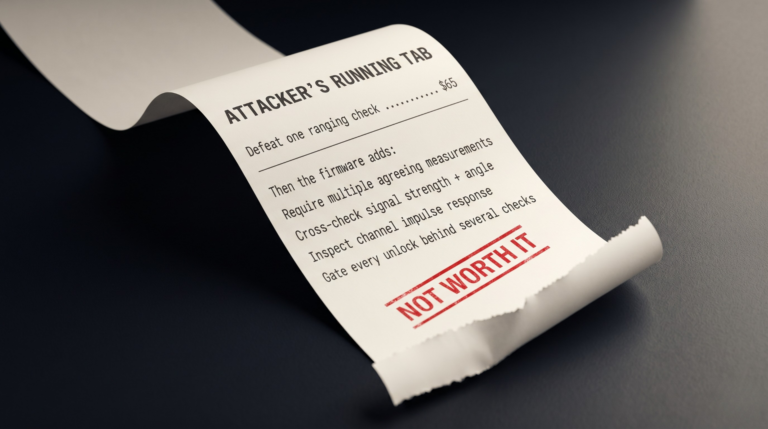
Good security makes an attack expensive enough that nobody bothers. Ghost Peak costs sixty-five dollars and a little patience today. Firmware’s job is to run that bill up until the attacker gives up. Here are four moves for that:
| Best practice | What it does | Why it works |
|---|---|---|
|
Require multiple measurements |
Act only after several consistent ranging results agree, never on a single fix |
Ghost Peak lands on a small fraction of single exchanges, so demanding agreement collapses the attacker’s odds |
|
Cross-check with a second signal |
Compare the time-of-flight distance against a sanity check from signal strength or angle |
A reading that contradicts itself gets discarded before it reaches the lock |
|
Inspect the channel itself |
Examine the full Channel Impulse Response (CIR: the record of how the pulse echoed off the room), beyond the reported distance |
The CIR carries the fingerprints of an injected pulse; a 2024 study flagged Ghost Peak attempts at over 99% this way |
|
Gate every irreversible action |
Never let one ranging result alone open, pay, or grant access |
Like a bank requiring two signatures for a large withdrawal, two independent checks are far harder to beat at once |
You own the one decision that matters most here: how many independent checks stand between a ranging result and an open door. Raise that number.
Picking a Radio Is Harder Than It Looks
Choosing a radio for a product is a research problem before it is an engineering one. The datasheet will tell you the range and the power draw. It will stay silent on whether a chip’s first-path detection survives an injected pulse, or which attacks have been published against the silicon you are about to commit to. That answer lives in security papers, standards drafts, and test benches, and finding it takes time most teams do not have.
This article is one slice of that work. Pulling apart the secure-ranging claim, tracing the attacks back to primary research, separating what the standard guarantees from what the vendor decides: that is the kind of digging embedUR does before a radio ever reaches a schematic. UWB is one radio among several we have taken apart this way, and the security layer is one question among many that decide whether a wireless product ships on schedule or stalls in certification.
That is the expertise we bring to a radio decision. We read the security papers so your roadmap inherits answers rather than surprises, and we know which questions separate a vendor who has studied distance-reduction attacks from one who reaches for the compliance logo. All of it maps back to the product you are actually building.
If UWB sits behind anything in your roadmap that unlocks, pays, or grants access, the moment to stress-test the secure-ranging assumption is before the design freezes. embedUR runs 30-minute architecture reviews that map your ranging stack to its real attack surface and surface the receiver questions to put to your vendor.
So before your product ships on the strength of a distance measurement, ask the question the spec sheet leaves out: when someone spends sixty-five dollars to lie to your radio, what does your firmware do next?

