



The 100-Year-Old Radio in Your Car Key
Why Your UWB Design Has to Whisper
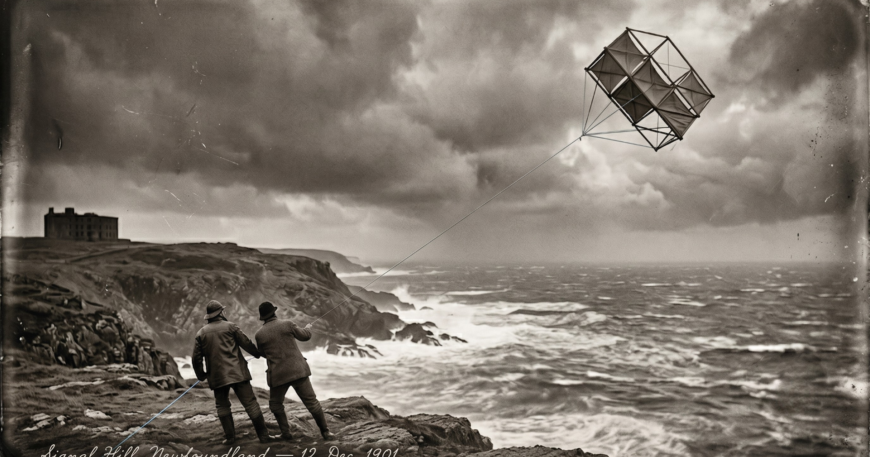
On the night of 12 December 1901, Guglielmo Marconi sat in a drafty room on a Newfoundland cliff with an earpiece pressed to his head, listening for a sound that had crossed an ocean. It came as three faint clicks. The letter S, in Morse code, sent from Poldhu, Cornwall, two thousand miles away.
The machine that sent it made radio the only way anyone then knew how: with a spark. A violent electrical snap that hurled energy across every frequency at once, one ragged burst smeared over the whole spectrum.
That smear has a modern name. We call it ultra-wideband.
The first signal to cross an ocean was a UWB transmission. So was the first radio signal ever made, coaxed from a spark by Heinrich Hertz in 1887. Sit with what that means for a moment. The radio deciding whether to unlock your car this morning is running the oldest idea in wireless.
We have shared five articles on this radio: how to choose it, what its next standard adds, what it can sense, where it truly ships, and how researchers broke its security for sixty-five dollars. This one reaches further back than all of them, to where the constraints came from.
The tight link budget you fight over on every project, the anchor count that swells every deployment quote, the curious fact that the newest standard reaches farther by listening longer instead of transmitting harder: all of it traces to a single decision, made about this radio, long before you were born.
This is the story of the century UWB spent buried, and of the one rule that has governed every design choice since it was dug back up.
The World Chose Narrow
Marconi’s spark worked, but it was also a menace. You see, a spark-gap transmitter throws out a damped, sprawling wave that lands on every frequency within reach. Put two of them near each other and they trample each other’s messages. For a while, the young world of radio simply shouted over itself.
Then came a cleaner idea: a continuous wave, tuned to a single frequency. Unlike Marconi’s “spark”, it packs all its energy into one narrow channel. It disturbs almost nothing beside it, and it carries farther on the same power. Radio reorganized itself around that principle.
The spark had no place in the new order. And by 1920 it was obsolete, displaced by the vacuum tube. By the mid-1930s, international agreements had pushed it off the air entirely. The first radio technology ever built had become contraband.
In the end, wideband fell silent, and stayed silent for most of a century.
The Underground Century
An idea that good will always find a way to survive. Everything that made the wide signal a nuisance in the open air made it a weapon behind closed doors. A pulse spread across a huge span of frequencies is razor-sharp in time, hard to jam, hard to intercept, and able to pass through soil and walls that stop a narrowband signal cold. So the militaries took it, and for decades the banished radio lived on inside classified programs, under assumed names: impulse, baseband, carrier-free, time-domain.
In the late 1960s it began to surface. Henning Harmuth, a professor at Catholic University of America, published the basic designs for wideband transmitters and receivers and set them loose in the open literature. Gerald Ross and Kenneth Robbins at Sperry Rand turned the ideas into patents, and the one granted to Ross in 1973 became the founding document of UWB communications.
A year later, an engineer named Rexford Morey built a wideband radar that could see into the earth, and the ground-penetrating radar industry grew out of it. Even the name arrived late: “ultra-wideband” was reportedly coined inside the US Department of Defense around 1989, a full century after the first spark.
Let Back In, On One Condition
By the 1990s, the airwaves had filled again, and engineers noticed something poetic. The old troublemaker had become the “politest” radio imaginable. A signal spread thin enough across a wide band could run beneath everyone else’s transmissions without disturbing a single one, the way a whisper passes under a conversation. The engineers began pressing the US Federal Communications Commission (FCC: the agency that decides who may transmit, and how loudly) to let the exile come home.
In February 2002, the FCC agreed. Its First Report and Order opened 7.5 GHz of spectrum, from 3.1 to 10.6 GHz, to unlicensed UWB. After some seventy years, the oldest radio was legal again.
It came back on one condition. It may only whisper.
The rule caps a UWB device’s emissions at minus 41.3 dBm per megahertz. Hold that number up to the light. It is the same ceiling the FCC sets for an unintentional radiator: the faint, accidental leakage a television or a computer monitor gives off simply by being switched on. About seventy-five nanowatts per megahertz. A UWB radio is forbidden, by law, from speaking any louder than the background electrical hum of the room it sits in.

Think of a reading room. You may enter, on the promise that your voice never rises above the murmur already in the air. Everyone else keeps talking at full volume. You make yourself understood inside a whisper, or you say nothing at all.
That single line in a 2002 regulation is why a UWB radio behaves the way it does. Everything downstream is a consequence of the whisper.
Consequence One: Short by Law
A radio that cannot raise its voice cannot reach far, and no cleverness on your bench repeals that. This is why UWB is a room-and-zone technology: precise across a few metres of clear line-of-sight, fading fast past a wall or across a wide floor. It is a candle you are forbidden to brighten. Enough light to read by up close. Invisible from across the hall.
So the next time you are squeezing milliwatts out of a power budget and agonizing over antenna efficiency, remember who your real opponent is. You are wrestling a limit written to keep a 1901 spark from waking the neighbours.
Consequence Two: Why Coverage Costs What It Costs
Short legal range carries a bill, and the decision-maker is the one who signs it. If each anchor covers only a small, clear zone, then blanketing a warehouse, a hospital wing, or a factory floor takes many anchors, and every one of them brings cabling, mounting, calibration, and commissioning. The density on a UWB deployment quote is simple arithmetic. A quieter radio covers less ground. A bigger space needs more of them.
Consequence Three: The Trick of Listening Longer
Here is the puzzle that makes the constraint visible. Earlier in this series we covered 802.15.4ab, the next UWB standard, and its promise of up to thirty times the range. Stop and ask the obvious question. How does a radio reach thirty times farther when the law forbids it from getting one decibel louder?
It listens longer.
The new approach leaves the volume alone. It stretches the ranging exchange across a longer window and gathers the faint signal’s energy patiently, drawing the whisper out of the noise by attending to it for more time. It trades time for reach, because time is legal and volume is against the rules.
You already know this trick. When someone speaks too softly across a noisy room, you cannot make them louder. So you ask them to say it again, slowly, and you lean in. The information still arrives. Collecting it simply takes longer.
The Whisper Still Rules
Does the ceiling ever lift? Rarely, and slowly. The exact limit shifts by region, a wrinkle, which our earlier article “The Honest State of UWB” covered in full. The deeper truth is that the argument never closed.
Consider one recent scene. In early 2026, the FCC granted Tesla a special waiver to place a UWB positioning radio on an outdoor charging pad, because the standing rules still assume UWB stays indoors and in your hand. A trillion-dollar carmaker had to raise its hand and ask permission to point this radio at the ground outside.
The dispute over how and where wideband may speak began before your grandparents were born. It did not end in 1934, or in 2002. It is still in session.
Design Inside the Whisper (With embedUR)

Strip a UWB stack down to its hardest tradeoffs and you keep arriving at the same place. The short range. The starved power budget. The anchor density. The newest standard’s decision to wait rather than shout. Each one is the living consequence of a rule about how loud one radio may be, argued over since the age of the spark.
The radio is old. The craft is in designing gracefully inside its one unbreakable rule, and that craft decides whether a UWB product ships or stalls in the lab. embedUR provides the expertise your team needs to build UWB stacks around the emission mask rather than against it. We help with sizing power budgets to the law, planning anchor density by the zone, and choosing the range strategy the constraint actually allows. Check out The Honest State of UWB right here.
So the next time a UWB link budget feels impossibly tight, remember what you are really up against. How do you build a radio that once crossed an ocean, when the one rule it must obey is that it may never speak above a whisper?

